Overview
There have been several studies which investigate the use of biomass as an alternative, sustainable energy source. Most of these studies have assumed biomass will be used as a general solution applied across an industry but this approach is not well suited to biomass as its composition, availability, and cost, vary significantly due to location, competition, scale etc.
When biomass is used to produce energy for industry, it is important to consider and understand the many different forms of biomass feedstock, and the many pathways in which biomass can be converted. The simplest method of biomass conversion is via direct combustion of the biomass into process heat however several other approaches such as torrefaction, pyrolysis or gasification or combination of those processes are also applied. These can be used to produce biomass-based fuels that are quite similar to the fossil fuels currently in use and hence, in principle, biomass can meet most industrial process heat needs. However, many of these technologies are not commercially mature and the cost of biomass can vary greatly between locations making it difficult to generalise about the cost competitiveness of biomass as a source of industrial process heat.
Project Details
This project looked at opportunities to identify specific applications/instances where biomass will be the preferred feedstock for the transition to a low-carbon industry/process. Understanding the opportunities for biomass to provide energy to industrial processes requires thorough understanding of the process, local feedstock availability, biomass chemical and physical properties and how appropriate logistics systems can be set up. Close collaboration between different supply chain actors and long-fuel supply contracts can often be key to providing the certainty needed to reduce investor risk. The scope of this project also includeds a potential role for biomass as a chemical reductant, not just as a source of heat.
Following a comprehensive literature review on the potential applications of biomass in various heavy industries, the project assessed the availability and current utilisation status of Australian biomass and waste, categorised into four main sources: agricultural residues, forestry residues, industry-processing residues, and urban wastes. It identified that forestry residues represent a largely untapped resource with significant potential to contribute to the decarbonisation of Australia’s heavy industries.
Through its industry engagement activities, the research team visited Grange Resources’ facilities in Tasmania, and South32’s Worsley Alumina refinery and the Forest Products Commission’s operations in Western Australia.
Research Areas
Blending of alternative low-carbon fuels for current high temperature processes
Progress and Results
February 2026
Drawing on resource mapping, technoeconomic analysis and case studies, this project clarifies where bioenergy can be technically viable, commercially competitive and strategically valuable.
The project final report finds that biomass and biomass-derived syngas can play a meaningful transitional and, in some cases, longer-term role in reducing emissions from high-temperature processes in sectors such as cement, lime, alumina and iron and steel. However, outcomes are highly location-specific and depend on feedstock availability, logistics, competing uses and policy settings.
Key takeaways for industry
- Bioenergy can provide near-term emissions reductions in applications where full electrification or green hydrogen are not yet commercially viable, particularly for high-temperature heat and fuel substitution.
- Regional feedstock availability is the critical constraint. While Australia has significant biomass resources, supply is uneven and often contested. Industrial hubs located near concentrated, low-cost biomass streams are best positioned to benefit.
- Cost competitiveness depends on logistics and scale. Transport distances, preprocessing requirements and integration with existing plant infrastructure strongly influence delivered fuel costs and overall economics.
- Biomass-derived syngas offers flexibility for blending with existing fuels but requires careful management of gas quality and impurities to meet end-user specifications and protect equipment.
- Bioenergy’s most strategic value may lie in complementing electrification, hydrogen and energy efficiency measures, and reducing reliance on a single decarbonisation pathway.
The final report is available for project partners via HILT Hub.
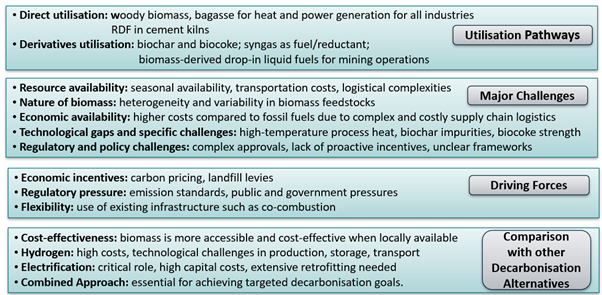
Summary of the key insights gathered from interviews with stakeholders:
Carbon balance for different energy systems: Created based on the concepts from Evans et al. (2010)*:
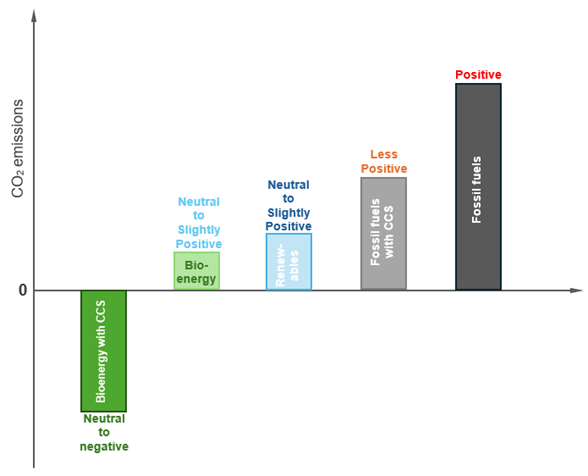
* Evans A, Strezov V, Evans TJ, Sustainability considerations for electricity generation from biomass. Renewable and Sustainable Energy Reviews, 2010. 14(5): p. 1419-1427.
May 2025
RP2.012 evaluated the feasibility of integrating biomass into heavy industrial processes, considering factors such as feedstock availability, supply chain logistics, technological challenges and economic feasibility.
The project developed two case studies exploring the potential to replace natural gas with biomass-derived syngas in the iron ore pellet-making process (Grange) and the alumina calcination process (South32). Findings included:
- The cost-effectiveness of syngas is influenced by biomass cost, transportation logistics and plant capital expenditure.
- Scaling up gasification facilities does not always reduce costs due to increased biomass transportation expenses.
- Sensitivity analysis of the preliminary technoeconomic model showed that biomass-derived syngas costs vary between $11.4 and $17.1/GJ.
For iron ore pellet-making, fuel costs were relatively low as biomass can be sourced within 50-60 km. For alumina calcination, with biomass sourced from 200 km away, transportation costs affected feasibility.
Overall, the project demonstrated that the use of biomass (or its derivatives) as a pathway to decarbonise heavy industry in Australia continues to show promise.
A follow-on project, RP2.018, has been approved.
Project Summary
HILT CRC Project Summary RP2.012 Opportunities for Bioenergy in Australian Heavy Industry