Overview
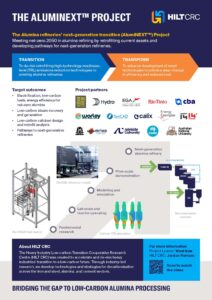
The AlumiNEXT™ Project explores innovative ways to decarbonise alumina refineries by transitioning from natural gas combustion to hydrogen or electrification in the calcination process and achieving net-zero steam generation and recovery within the Bayer Process (refining bauxite ore to produce alumina).
The project addresses the short-term need to: (a) de-risk relatively high technology readiness level (TRL) technologies that can retrofitted into current alumina refineries to reduce emissions; and (b) develop novel technologies to unlock a step-change in efficiency, reduced CO2 emissions, and reduced cost in next-generation net-zero refineries.
The project aims to de-risk high-readiness technologies with strong potential to reduce emissions and explores novel approaches to unlock significant efficiency gains using low-carbon energy sources. By targeting key processes in alumina production, the project aims to deliver practical, high-impact approaches to decarbonisation.
View the AlumiNEXT™ animated explainer video:
Download the AlumiNEXT™ flyer:
Project Details
AlumiNEXT™ is driving the transition of alumina refineries to net-zero CO₂ emissions by addressing both transitional low-carbon solutions for the short and medium term and transformational net-zero technologies for the long term.
The project aims to develop and demonstrate steam recovery technologies, including thermal vapour recompression (TVR) and mechanical vapour recompression (MVR), to improve efficiency and reliability. Preliminary assessments suggest these approaches can make net-zero alumina production economically viable, with competitive costs compared to natural gas when carbon impacts are considered.
The project focuses on:
- Achieving net-zero steam generation and recovery within the Bayer Process (refining bauxite ore to produce alumina) to improve the sustainability and efficiency of alumina production. This involves optimising existing processes and integrating innovative technologies to reduce emissions.
- Decarbonising the energy-intensive calcination process, the final heating step in alumina production, where hydrated alumina (aluminium hydroxide) is heated to very high temperatures to remove chemically bound water, converting it into pure alumina (aluminium oxide). This research component will develop strategies to significantly lower calcination’s carbon footprint.
These two project components are further divided into research areas that address specific challenges and opportunities, ensuring that AlumiNEXT™ systematically tackles barriers to decarbonisation.
HILT CRC Milestones
- 1.3 Low-carbon high-temperature alumina calcination
- 1.4 Low-carbon heat for the hydrometallurgical process component of alumina refining
Research Areas
- Storage of variable renewable energy and capture of waste heat for steam production
- Hydrogen or electric calcination assessment
Planned Outcomes
- Cost-benefit analyses for steam generation methods across diverse plant and country scenarios.
- CO₂ reduction and levelised cost of alumina production assessed for current process configurations.
- Case studies demonstrating benefits of optimised systems.
- Evaluations of benefits and challenges of waste heat recovery.
- Cost and performance models incorporating system scale, temperature, working fluids and renewable energy inputs.
- Cost and performance models for processes using alternative heat transfer media, optimised for economic and operational feasibility.
- Enhanced process efficiency and sustainability through novel media integration.
- Strategies to retrofit existing calciners with electrification methods for improved operational stability.
- Assessed thermal energy storage (TES) integration to stabilise alumina calcination under fluctuating energy supplies.
- Designs for preliminary lab-scale net-zero alumina calciners.
- Experimental data for alumina particle behaviour in net-zero reactor conditions to optimise scaling.
- Insights into alumina product properties for improved reactor designs.
- Insights into fluid dynamics, heat transfer and reactor operation to support industrial scale-up.
- Improved understanding of particle behaviour for agglomeration and steam recovery for MVR.
- Assessments of durability, corrosion, wear resistance and thermal stress management in new calciner designs.
- Evaluations of feasibility and reactor design for a two-stage calcination process to enhance efficiency.
- Preliminary designs integrating waste heat recovery for net-zero calcination processes.
- Analyses of benefits and challenges of waste heat recovery.
- Cost and performance models for waste heat systems incorporating renewable energy inputs.
Progress and Results
February 2026
The first milestone report sets out a practical decarbonisation path for alumina refineries. Key progress includes:
- Established AlumiNEXT SysCAD process models for generic1Mt/year high-temperature and low-temperature Bayer circuits, covering the range of input conditions relevant to the operating conditions of industry partners, and reasonably representing mass and energy flows. These models will be used to support scenario analysis and decarbonisation pathway evaluation.
- Identified preferred waste-heat recovery sources from the AlumiNEXT process models, considering relevant temperature ranges, pressures and associated process conditions across representative plants. Future work will prioritise these streams for detailed technoeconomic and integration studies.
- Established decarbonised configuration options for steam production. A heat-exchanger-based system integrated with thermal energy storage (HEX-TES), using molten salt as both the heat-transfer fluid and storage medium, has been selected as the reference steam-generation system for detailed technoeconomic and integration studies. Next, this configuration will be further optimised and benchmarked against alternative pathways, including electric boilers and different heat-transfer fluid options.
- Identified key kinetic parameters for alumina calcination in the presence of steam, based on a comprehensive literature review. These parameters will inform experimental design and reactor modelling for steam calcination trials.
- Completed the AlumiNEXT drop tube reactor design for steam calcination experiments, including completion of hazard identification (HAZID) and operability (HAZOP) studies. The next phase will focus on reactor construction, commissioning and experimental validation.
- Undertook a preliminary comparative study of hydrogen and natural gas operation in alumina calcination, based on circulating fluidised bed (CFB) simulations. Further simulations and sensitivity analyses will be conducted based on various syngas (H2 + CO) to assess combustion performance, emissions and scale-up implications.
Project Benefits
- Electrification of the calcination process, including the use of thermal storage, to significantly reduce CO₂ emissions.
- Development of alternative calcination methods, such as hydrogen and solar thermal, to provide
low-carbon heat. - Continuous steam generation with low or zero emissions.
- Recovery and reuse of waste heat from the calcination process to support the Bayer Process.
- Advanced steam integration designs to enable recovery of steam and waste heat lost during production.
- Understanding of how to retrofit and adapt existing plant designs and equipment to minimise disruption and reduce costs.
- De-risking high-TRL technologies for immediate retrofitting to reduce emissions in current refineries.
- Advancing novel technologies for next-generation refineries to achieve a step-change in efficiency, emissions reductions and cost savings.
- Development of process models and components tailored to specific refinery needs, ensuring the integration of low-carbon heat sources and efficient steam-recovery designs.
- Improved resilience and future-proofing of energy infrastructure to meet the evolving needs of heavy industry by incorporating scenarios and technology developments into predicting future energy supply and demand trends.
Published Scientific Papers
- Lee L, Ingenhoven P, Saw WL, Nathan GJ. The techno-economics of transmitting heat at high temperatures in insulated pipes over large distances. Applied Energy. 2024; Vol. 358, 122634.
Download the Project Summary
RP1.013 Alumina refineries’ next-generation transition (AlumiNEXT™) Project
Case Study