Virtual Event
- This event has passed.
HILT CRC Partner Webinar: Rio Tinto’s BioIron™
June 9 @ 1:00 pm - 2:00 pm ACST
Virtual Event
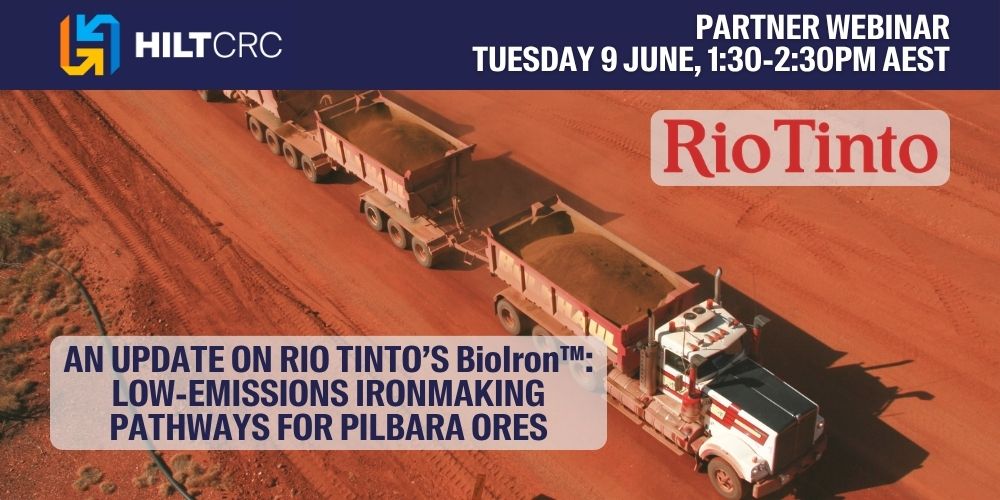
Earlier this year, Rio Tinto Iron Ore joined HILT CRC as a Key Partner, underscoring the company’s commitment to supporting the decarbonisation of the steel value chain.
BioIron™ is one of Rio Tinto’s steel decarbonisation initiatives, developed over the past decade. The process uses raw, sustainable biomass – agricultural by-products like wheat, canola and barley straw, seed husks and sugarcane bagasse, energy crops such as sorghum, bamboo and Miscanthus giganteus, and woody forestry and municipal wastes – and microwave energy to convert Pilbara iron ore to metallic iron. It has the potential to reduce carbon emissions by up to 95% compared with the blast furnace route when combined with renewable energy and carbon circulation of biomass. The electricity consumption in the BioIron process is estimated to be about one third of the electricity required by other steelmaking pathways that rely on renewable hydrogen.
The company is continuing to develop BioIron™ and is inviting partners to help advance its path to commercialisation.
Join us for an update on the science behind BioIron and Rio Tinto’s ongoing work to progress low-emissions ironmaking pathways for Pilbara ores.
Agenda
- Welcome – 5 mins (Jenny Selway, CEO, HILT CRC)
- BioIron technology – 20 mins – Michael Buckley, Manager Technical Development BioIron™, Rio Tinto
- Microwave technology – 20 mins – Prof. Chris Dodds, Head of Department, Chemical and Environmental Engineering, University of Nottingham
- Audience Q&A – 15 mins.
Microsoft Event Terms and Conditions
SPEAKERS
Michael Buckley, Manager Technical Development – BioIron™, Rio Tinto

Michael Buckley graduated from the University of Queensland with a Bachelor of Engineering in Materials Engineering. His original interest was in high performance ceramics, which led him to join Rio Tinto’s alternative ironmaking HIsmelt Project as a refractories specialist. When much of the refractory in this project was replaced with water-cooled panels he began to focus more on ironmaking metallurgy and held roles in operations, technical development, maintenance, marketing and strategy for alternative ironmaking.
In 2007, Michael joined Rio Tinto Iron Ore’s Technical Marketing team and began examining options for decarbonising iron and steelmaking with Pilbara-type iron ores. When he realised some of limitations of both natural gas and hydrogen-based processing of these ores, he started to look at the use of raw sustainable biomass as a reductant and microwaves as an energy source. In conjunction with the University of Nottingham and Metso Outotec (now SMS), the BioIron™ process was developed. The technology is now ready to be taken to the large-scale pilot plant stage.
Professor Chris Dodds, Head of Department, Chemical and Environmental Engineering, University of Nottingham

Professor Chris Dodds is Head of Department, Chemical and Environmental Engineering at the University of Nottingham. He chairs Heads of Chemical Engineering UK and Ireland, leading collaboration between institutions and external stakeholders. He leads a highly multidisciplinary research group that conducts R&D and commercialisation studies into microwave heating technologies that deliver economic and technical benefits across a wide range of applications and sectors.
Chris currently coordinates over £15m of research projects. He works with global industries, companies and research collaborators on projects from laboratory to large industrial scale, with highly commended Research Excellence Framework (REF) impact case studies from 2014 and 2021. His research achievements have been recognised with multiple awards, including The Royal Academy of Engineering Campbell Mitchell Award, more than 100 patents and over 60 journal papers.
Jenny Selway, Chief Executive Officer, HILT CRC
 Jenny Selway has over 20 years’ experience as an engineer and non-executive director, with expertise in decarbonisation and the energy transition. Prior to her role as CEO of HILT CRC, she worked across the energy industry at the Australian Energy Market Operator (AEMO), where she focused on increasing renewable penetration in the Victorian transmission network, and at ExxonMobil, specialising in international joint venture and asset management. She is also currently a non-executive director at Gippsland Water.
Originally graduating from the University of Adelaide with a Bachelor of Engineering (Hons) and Bachelor of Science, Jenny is also a graduate of the Australian Institute of Company Directors and a Fellow of Engineers Australia. She has completed an Executive MBA from Melbourne Business School and postgraduate studies into Climate Change Policy at the Australian National University.