
Virtual Event
- This event has passed.
HILT CRC project webinar: De-risking Australian ores in fluidised bed direct reduced iron
May 27 @ 1:00 pm - 2:00 pm ACST
Virtual Event
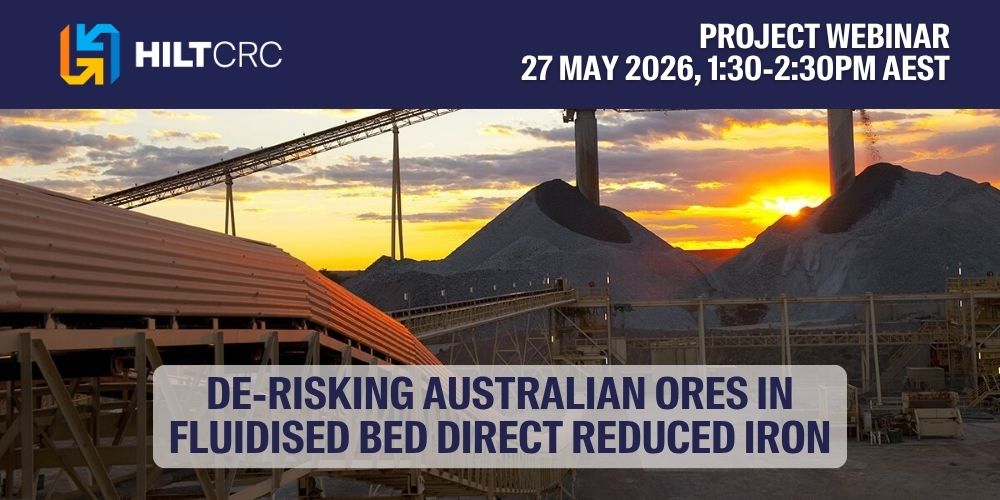
Join us for a webinar on HILT CRC project RP1.012 Prevention of sticking in H₂ fluidised bed direct reduced iron production. This project is addressing one of the key technical barriers to hydrogen-based direct reduced iron (DRI) from Australian ores: how to maintain stable fluidised bed operation while avoiding sticking and defluidisation.
Bringing together complementary research from The University of Newcastle (UON), The Australian National University (ANU) and Swinburne University of Technology (SUT), the project is building a more complete picture of ore behaviour, reduction kinetics, anti-sticking strategies and downstream materials handling – highlighting the value of a collaborative approach to de-risking future green iron pathways based on Australian ores.
The webinar will highlight recent research findings from the project, including:
- reduction conditions strongly influence how metallic iron forms on ore particles
- higher temperatures and hydrogen concentrations increase the tendency to form dense iron layers that hinder gas permeability and raise sticking risk
- for the Australian hematite–goethite ores tested, acceptable reduction without sticking was achieved at 700–800 °C, identifying a promising operating window for further development.
Presenters will include project leader Assoc. Prof. Tom Honeyands (project leader) and Dr Rou Wang from UON, Dr Shabnam Sabah from SUT and Prof. John Pye from ANU.
John will also give an update on the ARENA-supported extension of RP1.012.
Rachelle Doyle, Research Leader, HILT CRC Program 1 (Process Technologies), will introduce the speakers and moderate the audience Q&A.
Microsoft Event Terms and Conditions
SPEAKERS
A/Prof. Tom Honeyands, Director – BHP Centre for Sustainable Steelmaking Research, University of Newcastle
Prior to joining the University of Newcastle in 2015, Tom Honeyands spent 20 years working in an industrial R&D environment and 6 years as a metallurgical consultant. While at BHP Billiton Research (1995 to 2009), he worked on a range of industrial research spanning continuous casting of steel; steelmaking; manufacturing, transport and use of direct reduced iron; manganese smelting; and iron ore geometallurgy use in iron and steelmaking.
A key focus of Tom’s iron ore research was to define a link between fundamental iron ore properties and their performance in ironmaking processes. While working for Creative Process Innovation, he developed the Marx Value in Use (VIU) model which has been applied on more than 35 VIU studies for major and junior iron ore miners. He also led the AMIRA P1097 project on transportable moisture limit (TML) of iron ores and the P1150 project on moisture measurement and control for iron ore conveyor systems.
Tom’s areas of expertise include characterisation of ironmaking raw materials relevant to their end-use (e.g. iron ore for sintering, iron ore sinter, lump and pellets for blast furnace ironmaking); applied research with focus on understanding process fundamentals (e.g. the iron ore sintering and FINMET processes); and formulation of research programs to achieve desired, tangible outcomes (e.g. results that can be used in technical marketing and/or solve commercial-scale problems). He has delivered in-house iron and steelmaking training to iron ore miners (50 courses and almost 800 trainees).
Dr Rou Wang, Research Associate, University of Newcastle
Rou Wang completed her PhD project in the Department of Chemical Engineering at the University of Newcastle, where she currently works as a research associate in BHP Centre for Sustainable Steelmaking Research. As well as working on HILT CRC project RP1.012, Rou has expanded her research on advanced carbon materials for energy storage and fluidisation behaviour in ironmaking.
Dr Shabnam Sabah, Postdoctoral Research Engineer (Green Steel Alliance), Swinburne University of Technology

Shabnam Sabah leads HILT CRC project RP1.015 ‘De-risking flash reduction of Australian iron ores’. She has worked on several other HILT projects, including ‘Prevention of sticking in H₂ fluidised bed DRI production’, ‘Impact of hydrogen DRI on melting in an electric Furnace’, ‘Hydrogen Ironmaking: fluidised bed H₂DRI with Australian focus’, and ‘Testing of Australian Iron Ores in a hydrogen direct flash smelting process’.
In her role at Swinburne, Dr Sabah focuses on decarbonising the ironmaking and steelmaking industry through technoeconomics, characterisation and process modelling. She also manages the research activities of the Swinburne Green Steel Program. Dr Sabah completed her PhD on splashing behaviour of basic oxygen furnaces at Swinburne. She worked in the process industry after finishing her bachelor’s degree in mechanical engineering from Bangladesh University of Engineering and Technology.
Professor John Pye, Australian Solar Thermal Research Institute, The Australian National University

John Pye has a background in mechanical engineering with an emphasis on thermal energy systems including system design, heat transfer, non-imaging optics, computational fluid dynamics, thermodynamics and simulation. His recent focus is on system-level design optimisation, heavy industrial decarbonisation, fluidised bed ironmaking and biomass gasification. John led HILT CRC Project RP2.008 Lost production and variability as well as an ARENA-funded project on de-risking hydrogen ironmaking.
Rachelle Doyle, Leader, Program 1 – Process Technologies, HILT CRC

Rachelle Doyle is a Perth-based chemical engineer and senior R&D leader with 30+ years’ experience in diverse roles across iron ore, energy and alumina. She serves on several Curtin University advisory bodies (Chair, Chemical Engineering & Corrosion Centre Advisory Group; member, Curtin Institute of Energy Transition Industry Advisory Board) and on Adelaide University’s Centre for Energy Technology Advisory Board, bringing deep industry–research connectivity and portfolio management experience. She has built and led substantial research portfolios and partnerships, including a ~$90 million annual R&D program at Rio Tinto Iron Ore spanning early-phase research through to scaled field demonstrations.
Career highlights include leading technology teams and R&D portfolios at Rio Tinto (Iron Ore) and Fortescue Future Industries, shaping Woodside’s technology and new energies strategies, global implementation of process safety practices for Chevron, and early-career roles at Queensland Alumina (working for Hatch Kaiser Engineers) and Alcoa.
Rachelle’s contributions to technology development in Australia were recognised in 2024 when she was named a Fellow of the Australian Academy of Technological Sciences and Engineering (ATSE). She is also a fellow of the Institution of Chemical Engineers (IChemE), a Chartered Professional Engineer and Deputy Chair of IChemE Australia, and has chaired Standards Australia’s Hydrogen Technologies Committee, helping deliver more than 30 standards since 2019.