Virtual Event
- This event has passed.
HILT CRC Public Webinar: Decarbonising alumina – AlumiNEXT™ and future pathways
July 15 @ 2:00 pm - 3:00 pm ACST
Virtual Event
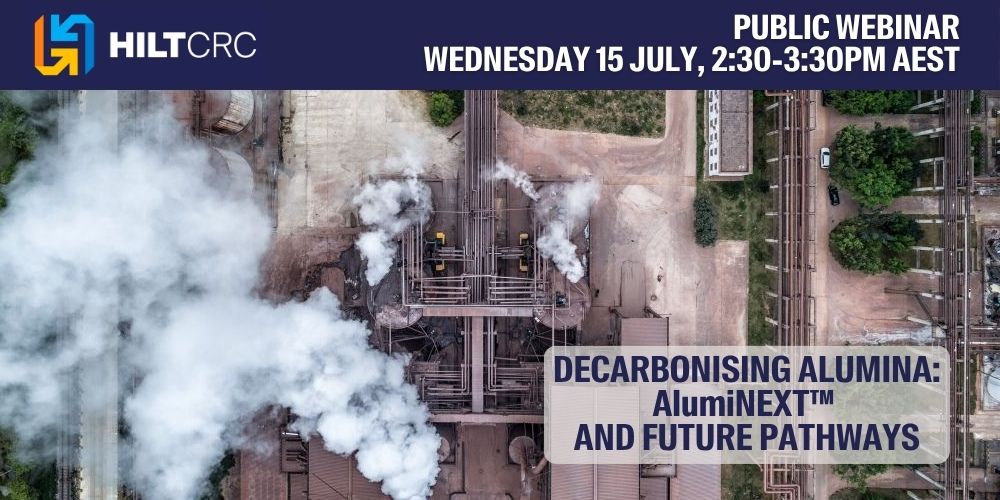
Join HILT CRC for a webinar on alumina decarbonisation, featuring an update on RP1.013 Alumina refineries’ next-generation transition (AlumiNEXT™) Project and a broader discussion of the technologies, integration challenges and industry priorities shaping the transition to low-carbon alumina.
AlumiNEXT™ is focused on two major emissions-reduction pathways for alumina refining: achieving low- or zero-emissions steam generation and recovery within the Bayer Process, and decarbonising calcination through hydrogen, electrification and other low-carbon heat options.
A/Prof. Woei Saw (Adelaide University), AlumiNEXT™ research leader, will present a project update, including recent progress across reactor design, modelling, steam recovery, calcination studies and industry-led integration priorities. Prof. Gus Nathan (Adelaide University and HILT CRC Research Director) will provide a technical perspective on the current status and future of alumina decarbonisation, considering how emerging technologies can be combined into practical refinery transition pathways.
From an industry perspective, Emilio Pai (Emirates Global Aluminium) will discuss EGA’s activities and priorities as a producer and user of alumina, and Marghanita Johnson (CEO, Australian Aluminium Council) will provide a broader view of the sector’s decarbonisation challenges and opportunities.
The session will explore what is technically promising, what still needs to be de-risked, and how industry, researchers and technology providers can work together to bridge the gap to low-carbon alumina processing.
SPEAKERS
Marghanita Johnson, Chief Executive Officer, Australian Aluminium Council
 Marghanita Johnson has been the Chief Executive Officer of the Australian Aluminium Council (AAC) since 2019. She has over 25 years’ experience in the Australian mining and manufacturing sectors, predominantly within the aluminium industry. Prior to joining AAC, she led government engagement and advocacy on behalf of Rio Tinto’s Pacific Aluminium assets and prior to that held key climate and sustainability roles at Rio Tinto.
Marghanita has Environmental Engineering and Chemistry degrees from the University of Western Australia. She is currently a Non-Executive Director of Alpha HPA Limited, Australian Industry Greenhouse Network and the Energy Users Association of Australia. She has previously been a non-executive director on the boards of the New Zealand Aluminium Smelter and the Tomago Aluminium Company.
Gus Nathan, Professor in Mechanical Engineering at Adelaide University and Research Director, HILT CRC
Prof. Gus Nathan is a Professor in Mechanical Engineering at Adelaide University, a Fellow of the Academy of Technological Sciences and Engineering, the Combustion Institute and Engineers Australia, a recipient of a Discovery Outstanding Researcher Award from the Australian Research Council and an ATSE KH Sutherland medallist. He was the bid leader for and is now the Research Director of HILT CRC. This builds on his leadership of an ARENA-funded program to develop technology with strong potential to provide energy to the Bayer alumina process with concentrated solar thermal heat in partnership with Alcoa and Hatch, together with his co-leadership of program to develop innovative hydrogen production technologies within the Future Fuels Cooperative Research Centre.
Gus has led the development of six technology platforms, three of which are in ongoing commercial use and include the flame for Sydney Olympic Relay Torch, while three are currently being upscaled to decarbonise heavy industry. Gus has published more than 300 papers in international journals, 250 in peer reviewed conferences, 50 commissioned reports and 13 patents. He is also the founding chair of the High Temperature Minerals Processing (HiTeMP) Forum and co-founder of the Hydrogen Production Technologies (HyPT) forums, both of which attract some 170 delegates from more than 13 countries, drawn equally from industry, research and government agencies. He is also a joint founder of the international ISF Workshop for the Measurement and Computation of Reacting Flows With Carbon Nanoparticles, which engages some 100 researchers from around the world and is aligned with his own speciality in optical diagnostic methods to de-risk emerging technologies in hydrogen production and heavy industrial processes.
Associate Professor Woei Saw, School of Chemical Engineering, Adelaide University

Woei Saw is an Associate Professor in the School of Chemical Engineering at Adelaide University. His research focuses on the decarbonisation and intensification of high-temperature industrial processes through the integration of renewable energy, advanced reactor technologies and process systems engineering. He has a strong track record in the development, scale-up and demonstration of novel technologies for low-carbon processing in energy- and emissions-intensive industries. His expertise spans high-temperature reaction engineering, fluidisation, thermal conversion technologies, process integration and technoeconomic assessment. He has extensive experience in the design, construction and operation of pilot-scale systems, and is adept at translating laboratory concepts into industrially relevant technologies.
A major focus of A/Prof. Saw’s research is the decarbonisation of alumina refining and other high-temperature industrial sectors. He is the inventor of a patented net-zero steam alumina calcination technology, which enables steam generated during alumina calcination to be recovered and reused in bauxite digestion within the Bayer process, significantly reducing overall energy consumption and greenhouse gas emissions. He currently leads HILT CRC’s AlumiNEXT™ Project, which aims to enable the transition to net-zero alumina refining through electrification and hydrogen pathways. AlumiNEXT™ integrates fundamental studies of alumina calcination, the development of next-generation low-carbon calciner technologies, and technoeconomic assessments to support industrial implementation.
Emílio Pai, Director of Process Engineering, Emirates Global Aluminium

Emílio is a process engineering leader with 26 years of experience in the mineral processing industry, specialising in energy, bauxite refining and alumina production. He has held key technical roles across global operations, including Technical Superintendent at Alcoa Aluminio SA, Pocos de Caldas, and Technical Manager at Jamalco (Alcoa Minerals of Jamaica). Since March 2015, he has served as Senior Manager/Director of Process Engineering at Emirates Global Aluminium (EGA), based in the UAE.
Throughout his career, Emílio has contributed to operations across Alcoa Refineries in Brazil, Australia and Jamaica, gaining broad international expertise in refining technologies and process optimisation. At EGA, he is actively supporting the development and implementation of decarbonisation initiatives for alumina refinery. He holds a BSc in Chemical Engineering and is a currently completing an MSc in Energy at Heriot-Watt University.
Rachelle Doyle, Leader, Program 1 – Process Technologies, HILT CRC

Rachelle Doyle is a Perth-based chemical engineer and senior R&D leader with 30+ years’ experience in diverse roles across iron ore, energy and alumina. She serves on several Curtin University advisory bodies (Chair, Chemical Engineering & Corrosion Centre Advisory Group; member, Curtin Institute of Energy Transition Industry Advisory Board) and on Adelaide University’s Centre for Energy Technology Advisory Board, bringing deep industry–research connectivity and portfolio management experience. She has built and led substantial research portfolios and partnerships, including a ~$90 million annual R&D program at Rio Tinto Iron Ore spanning early-phase research through to scaled field demonstrations.
Career highlights include leading technology teams and R&D portfolios at Rio Tinto (Iron Ore) and Fortescue Future Industries, shaping Woodside’s technology and new energies strategies, global implementation of process safety practices for Chevron, and early-career roles at Queensland Alumina (working for Hatch Kaiser Engineers) and Alcoa.
Rachelle’s contributions to technology development in Australia were recognised in 2024 when she was named a Fellow of the Australian Academy of Technological Sciences and Engineering (ATSE). She is also a fellow of the Institution of Chemical Engineers (IChemE), a Chartered Professional Engineer and Deputy Chair of IChemE Australia, and has chaired Standards Australia’s Hydrogen Technologies Committee, helping deliver more than 30 standards since 2019.