Overview
Heavy industry – particularly in the iron and steel, alumina and cement sectors – has identified affordable clean energy as a key priority for decarbonisation. There is a pressing need for information to help industry and government plan for energy infrastructure investment and development as it transitions to low-carbon operations.
This project will provide clear, data-driven estimates of energy costs to inform government policy and inform heavy industry on energy hub approaches, which require integrated energy infrastructure and services to provide reliable, affordable and sustainable energy solutions.
Project Details
This project aims to identify optimal and economically efficient energy supply options – including hydrogen, electricity and natural gas – for the industrial hubs that will be needed for Australia to achieve net-zero carbon emissions.
It will:
- consider different, regionally specific, scenarios for transitioning energy supply and heavy industry demand
- develop cost-optimised evaluations of the energy infrastructure needed to reach net-zero carbon emissions by 2050 for high-temperature industrial processes
- include assessments in hub locations in Bell Bay / Northern Tasmania, Upper Spencer Gulf (SA), Pilbara (WA), Port Hedland (WA), Kwinana / South West (WA) and Port Kembla (NSW).
Thorough, bottoms-up scenario-based energy supply-and-demand projections will model integrated electricity, hydrogen and green heat supply chains; infrastructure assessment; and stakeholder engagement. These models will optimise parameters such as energy utilisation, minimum investment, sustainability and reliable supply for industrial operations.
The project builds on RP 2.006 Hydrogen supply within HILT regional hubs – H2 cost and synergistic opportunities, which focused on hydrogen alone.
Research Areas
- Economic modelling of the low-carbon transition on the Australian economy
- Supply chain development, commercial pathways, commercialisation benefit assessments
Planned Outcomes and Benefits
- Energy demand and supply projections and modelling that will unlock the potential for co-investment and support the transition to a low-emissions future.
- Increased ability to accurately predict future energy demand patterns, which can be used by heavy industries to implement measures to lower overall energy costs.
- Increased understanding of how to optimise energy supply and demand for the types of energy and infrastructure anticipated to be most relevant, in ways that minimise investment or otherwise increase commercial viability.
- Increased understanding of the total system costs and risks of the various potential options for integrating renewable energy sources such as electricity and hydrogen into the supply chain and their impact on carbon emissions as well as alignment with sustainability goals and associated regulatory requirements.
- Improved understanding of energy supply-and-demand dynamics that will enable identification of potential energy supply vulnerabilities and hence implementation of measures to maintain energy security.
- Insights from analysis of the energy supply-and-demand model and different scenarios, which can be used to inform policies and incentives to support the transition of Australia’s energy system and heavy industry.
- Improved resilience and future-proofing of energy infrastructure to meet the evolving needs of heavy industry by incorporating scenarios and technology developments into predicting future energy supply and demand trends.
Progress and Results
February 2026
Decarbonisation reference scenarios developed
RP3.007 finalised its engagement methodology for developing stakeholder-validated decarbonisation reference scenarios.
A key milestone was the successful Gibbsite Alumina Reference Group workshop held in December 2025. This meeting brought together industry participants to test and refine shared assumptions and identified several critical challenges associated with refinery electrification – including transmission access, land use constraints and the need for coordinated public policy settings. The discussions reinforced that infrastructure planning and policy alignment will be central to enabling large-scale electrification of alumina operations.
Building on this foundation, the project has now commenced geographically focused streams for iron and steel hubs in the Pilbara and Upper Spencer Gulf (see below for a chance to provide input). These streams explicitly consider how ore type – particularly magnetite versus hematite – influences technology pathways, infrastructure requirements and investment risk.
For industry, the key value lies in the development of transparent, stakeholder-informed reference scenarios that can:
- clarify infrastructure needs at a regional scale
- test technology choices against ore characteristics and energy supply conditions
- inform coordinated investment and policy discussions.
The references scenarios developed in RP3.007 provide robust conditions to inform recommendations regarding unlocking energy infrastructure investment in future net-zero industrial hubs.
New insights into hydrogen certification and grid impacts
Two recent papers – published through Chengzhe (Kevan) Li’s HILT-supported PhD project at ANU and linked to RP3.007 – examine how hydrogen production interacts with electricity markets under different policy settings. The findings have implications for certification design, project economics and investment decisions.
- Li C, White LV, Fazeli R, Skobeleva A, Thomas M, Wang S, Beck FJ, Assessing emission certification schemes for grid-connected hydrogen in Australia, Communications Sustainability 1, 19 (2026).
This paper examines how electrolysers could interact with electricity markets and how certification settings affect hydrogen costs and electricity sector emissions.
Key takeaways for industry:
- Current methods under Australia’s Product Guarantee of Origin (PGO) scheme do not always accurately reflect actual emissions of grid-connected hydrogen.
- Geographic matching (sourcing renewable energy certificates from the same state in which the electrolyser is used) and yearly time-matching (sourcing certificates produced within one year of hydrogen production) can balance credible certification with cost control, while shorter time-matching tends to drive up costs with minimal additional benefit.
- Hybrid systems (grid plus co-located renewables) can reduce hydrogen costs while mitigating emissions, but outcomes depend on which generators increase output when electrolysers draw grid power.
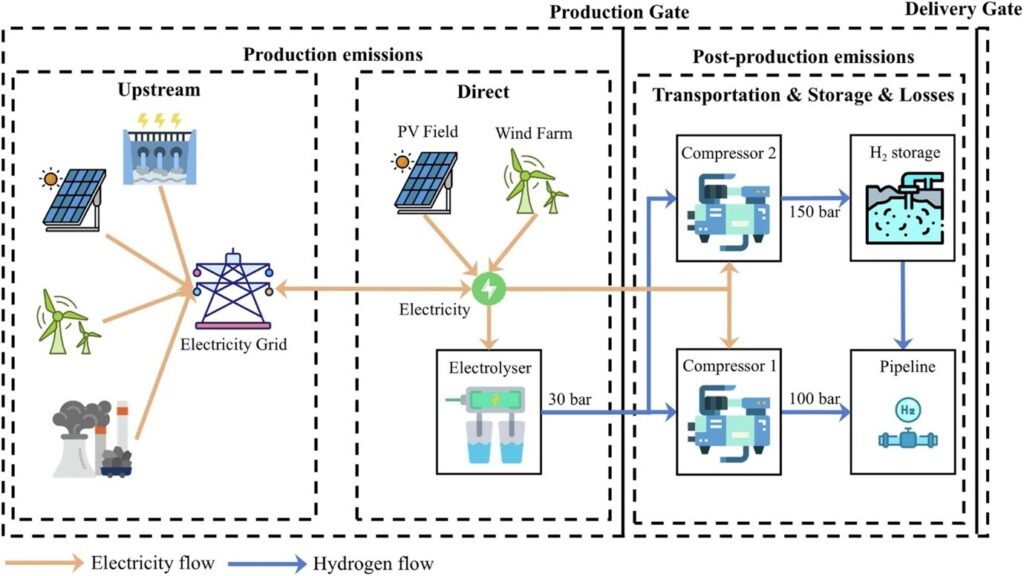
System boundaries for emissions accounting of hybrid grid-connected hydrogen production under the Product Guarantee of Origin scheme. The PV field and wind farm are co-located with and directly connected to the electrolyser:
- Li C, Beck FJ, Thomas M, How the interplay between grid characteristics and renewable resources determines optimal temporal correlation for grid-connected hydrogen certification, Energy Policy, Volume 212, 2026, 115158.
This study analyses cost and real-world emissions of grid-connected hydrogen production across more than 330 locations in the National Electricity Market (NEM) under different temporal correlation requirements – ensuring that the renewable electricity certificates are used to certify hydrogen are sourced within a particular time interval (from one year to one hour) before hydrogen production.
Key findings for industry include:
- Relaxed temporal constraints cannot eliminate emissions in all locations, particularly where grid electricity is cheap, but very stringent constraints (e.g. hourly) drive up costs with little emissions reduction in most locations.
- However, annual time-matching imposes economic incentives that act as an effective mechanism to curb excessive emissions by encouraging producers to locate in regions rich in renewable resources across the NEM.
- Application of a production tax incentive for low-emissions hydrogen further strengthens this incentive and significantly reduces costs, with a large number of locations with the best renewable resources leading to low-emissions hydrogen production costs below 2 USD/kgH2.
- In general certification, design needs to account for the interplay between renewable resource quality and grid characteristics is central to both cost and emissions outcomes.
Together, the two studies reinforce that certification design shapes investment decisions and should be structured to achieve the desired outcomes. Overly restrictive rules can increase costs without proportionate emissions benefits, however geographic matching and yearly time matching could support the emergence of a low-emission hydrogen industry while providing credible certification.
Published Scientific Papers
- Li C, Beck FJ, Thomas M, How the interplay between grid characteristics and renewable resources determines optimal temporal correlation for grid-connected hydrogen certification, Energy Policy, Volume 212, 2026, 115158.
- Li C, White LV, Fazeli R, Skobeleva A, Thomas M, Wang S, Beck FJ, Assessing emission certification schemes for grid-connected hydrogen in Australia, Communications Sustainability 1, 19 (2026).
Download the Project Summary
RP3.007 Project Summary – Unlocking investment in energy infrastructure for net-zero industrial hubs