ARENA-commissioned report’s five-step framework gives industrial heat users a practical pathway from initial assessment of thermal energy storage to investment decision.
Australian industrial businesses considering thermal energy storage (TES) now have an easy-to-use five-step framework to help evaluate the technology for their operations, both technically and commercially.
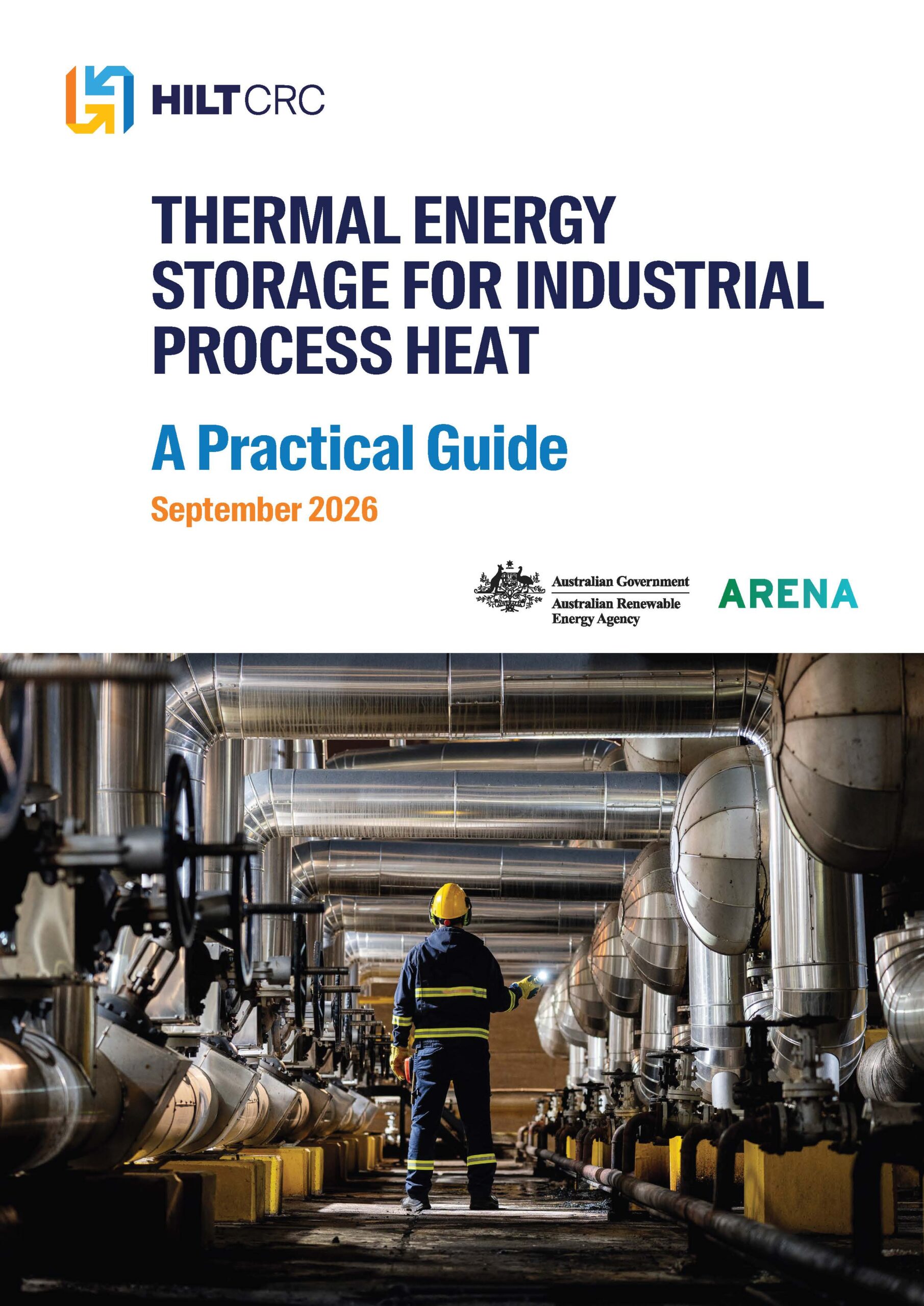
Commissioned by the Australian Renewable Energy Agency (ARENA) and developed by The Heavy Industry Low-carbon Transition Cooperative Research Centre (HILT CRC), Thermal Energy Storage for Industrial Process Heat: A Practical Guide was officially launched by ARENA at the 2026 Australasian Renewable Heat Conference in Melbourne.
Industrial process heat represents a major decarbonisation challenge. Australian industry used 234 TWh of process heat in 2022–23, with more than 80% supplied by fossil fuels and only around 3% electrified.
TES can help address this challenge by storing energy – including low-cost renewable electricity or waste heat – and supplying it as heat when industrial processes need it. However, evaluation requires careful technical and commercial assessment to ensure that TES meets a site’s process thermal needs and emissions targets at the lowest overall cost.
The new guide is designed to help industrial managers undertake early-stage evaluation, project scoping and decision-making.
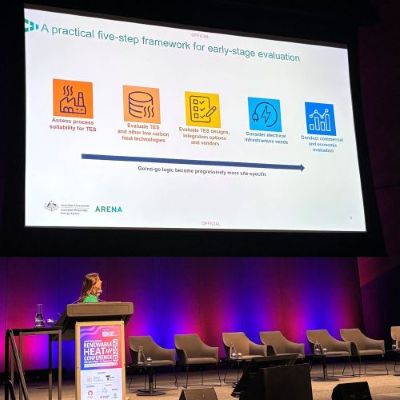
The five-step process guides users through:
- Assessing whether their industrial process is suitable for TES
- Comparing TES with other low-carbon heat technologies
- Evaluating TES designs, integration options and potential vendors
- Assessing electrical infrastructure requirements
- Evaluating the commercial business case and pathway to investment.
HILT CRC CEO Jenny Selway said the framework was designed to make a complex investment decision more manageable for industrial heat users.
“Companies looking to decarbonise process heat face a rapidly evolving range of technologies and vendors and it can be difficult to know where to start,” Ms Selway said.
“The five-step framework provides a practical starting point. It helps businesses work systematically from understanding their own heat requirements through to process integration, infrastructure requirements, costs and ultimately the investment case.”
Carl Christiansen, General Manager of Grid and Storage at ARENA, said industrial heat remains one of the biggest opportunities to reduce emissions in Australian industry.
“A large share of the heat used by Australian industry still comes from fossil fuels, so businesses need practical tools to assess lower-emissions alternatives,” Mr Christiansen said.
“This guide helps companies assess whether thermal energy storage could be a good fit for their operations and gives them greater confidence to pursue lower-emissions heat solutions.”
Professor Joe Coventry of The Australian National University led development of the report’s technical content with colleagues Dr Ahmad Mojiri and Dr Armando Fontalvo. Professor Coventry also leads HILT CRC research project RP2.017 Advancing the viability of high-temperature thermal energy storage for industrial applications.
“The starting question shouldn’t be ‘Which thermal energy storage technology should we buy?’ It should be ‘What does our industrial process actually need?’” Professor Coventry said.
“The key opportunity for TES is decoupling energy supply from heat demand. But getting the integration right is critical, which is why it is important to thoroughly evaluate the process, and consider TES as part of an integrated solution alongside other options including energy efficiency measures and alternative low-carbon heat supply options”
The report includes Australian and international case studies, information on more than 30 medium- and high-temperature TES vendors, key risks and knowledge gaps, and recommendations for industry, policymakers, regulators and investors.
Supporting appendices are also available, providing more detailed information on TES technologies and cost drivers, as well as practical integration case studies covering electrical infrastructure, alumina refining and high-temperature waste heat in steelmaking.
The report and appendices are available through the ARENA Knowledge Bank.
Downloads and resources
- Thermal energy storage for industrial process heat: A practical guide
- Thermal energy storage for industrial process heat: A practical guide (Appendices)
- Thermal energy storage for industrial process heat: Fact sheet
Media contact
Adam Barclay, Communications and Marketing Manager, HILT CRC
Mobile: +61 405 357 468, email adam.barclay@hiltcrc.com.au