A Heavy Industry Low-carbon Transition Cooperative Research Centre (HILT CRC) research team led by Professor Jacques Eksteen and Dr Lina Hockaday from Curtin University has received national recognition, winning the Cooperative Research Australia Award for Excellence in Innovation – Research Institution Leadership in Industry-Research Collaboration.
The award celebrates their leadership on the HILT CRC project Upgrading iron ore for direct reduced iron production using products from seawater reverse osmosis brines – a pioneering collaboration with Fortescue, Roy Hill, the Australian Renewable Energy Agency (ARENA), Agilitus, Proxa Australia, The University of Adelaide and the Minerals Research Institute of Western Australia (MRIWA).
The team is developing a novel hydrometallurgical process to upgrade lower-grade hematite and goethite ores into higher grades suitable for green steelmaking. By using desalination waste brine to remove impurities like silica and alumina, the process reduces waste and cost-effectively treats iron ores, with promising results to date.
“This technology addresses a critical challenge for Australia’s iron ore industry in the global transition to green steelmaking,” said Dr Hockaday. “By upgrading our abundant lower-grade ores to meet the stringent requirements of green iron and steel manufacturing, we’re helping secure Australia’s position in future low-emission steel supply chains.”
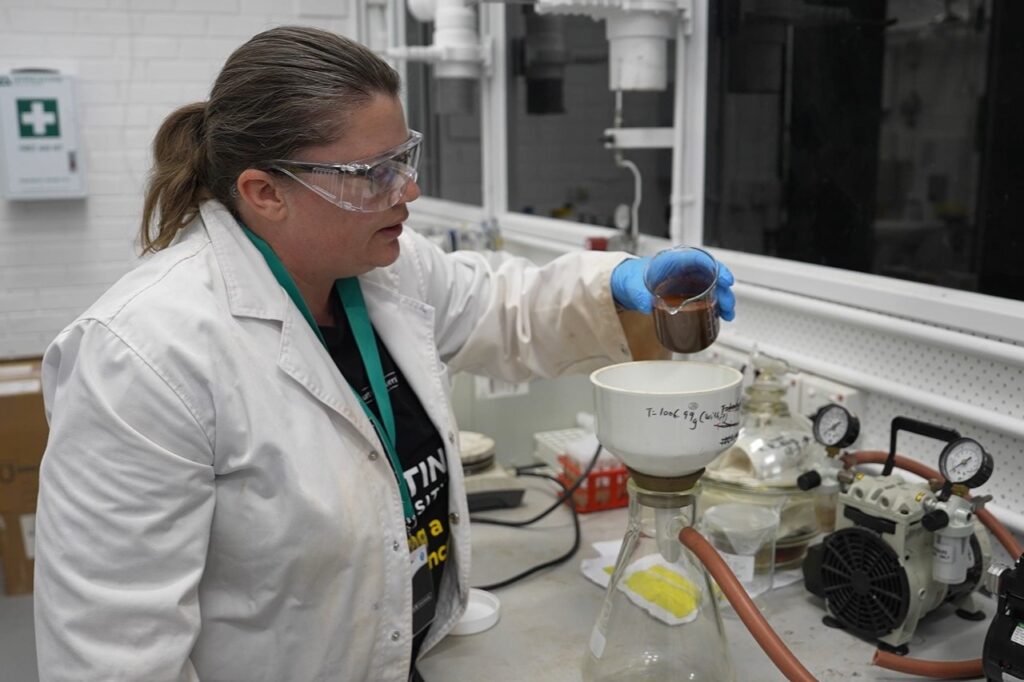
Dr Hockaday in her lab at Curtin University.
The strong partnership between industry and research has been essential to the project’s success, with companies providing ore samples, technical expertise and strategic guidance to ensure outcomes are commercially focused. HILT CRC CEO Jenny Selway noted that the Prof. Eksteen and Dr Hockaday’s collaborative approach has ensured that research priorities are shaped by industry requirements.
“By creating practical pathways to implementation, this project is a stellar example of industry-research collaboration that sits at the heart of HILT CRC’s mission: de-risking and accelerating heavy industry’s transition to net zero,” Ms Selway said.
To date, the process has upgraded four out of five ore samples from 55-60% iron content to above 65%, with the research team aiming for the 67% needed for green steel production.
At the same time, the approach is delivering other significant commercial and environmental benefits:
- Use of waste brine as a low-cost reagent
- Operating profit per tonne achievable at typical market prices for upgraded iron ore
- Potential access to price premiums for higher-quality ores
- Reduced energy requirements during smelting (2% less energy, 35% less slag)
- Elimination of tailings waste through >95% iron recovery
- Creation of valuable byproducts including zeolites, lithium salts, geopolymers and potable water.
A recent international patent application filing (PCT/AU2025/050193 Hydrometallurgical iron ore beneficiation process) underscores the progress of the technology from concept to commercial readiness.
The project has attracted over $5.4 million in funding, including $2.1 million from ARENA, with additional financial and in-kind support received from MRIWA and Curtin University.
Media contact
Adam Barclay, Communications and Marketing Manager, HILT CRC
Mobile: +61 405 357 468, email adam.barclay@hiltcrc.com.au