Virtual Event
- This event has passed.
HILT CRC public webinar: Optimising energy infrastructure development to provide reliable, affordable clean energy for industrial hubs
November 12, 2025 @ 1:00 pm - 2:00 pm ACDT
Virtual Event
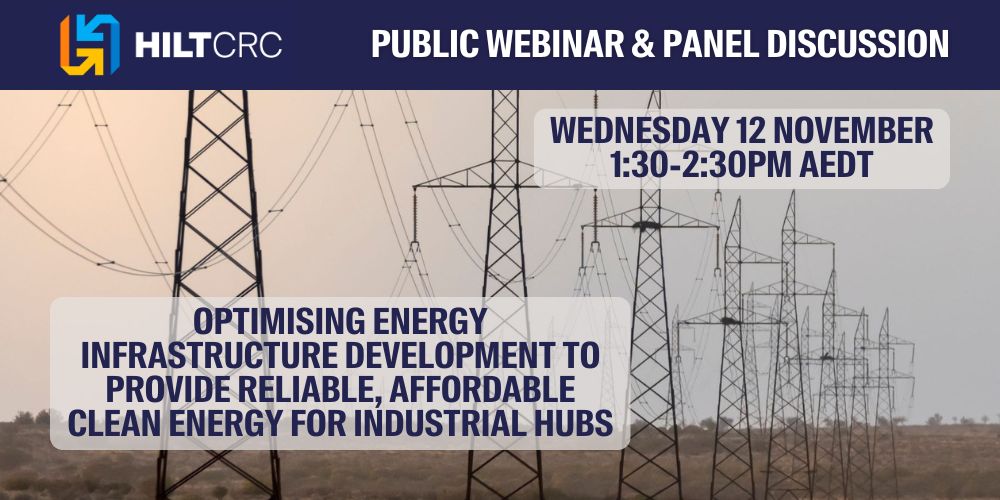
Join us for a dynamic panel discussion on the optimisation of energy infrastructure for reliable, affordable clean energy in the transition of heavy industry hubs.
The panel, to be moderated by CSIRO’s Dr Tara Hosseini, will feature Mitch Burt (South32 and Industry Chair of HILT’s Cross-cutting Technologies Program), Wayne Harris (OneSteel Manufacturing), Kim Enkelaar (Renewables, Climate and Future Industries Tasmania), Ben Saward (Grange Resources) and Professor Gus Nathan (HILT CRC and University of Adelaide).
The session will cover:
- how heavy industry low-carbon transition pathways may change energy demands
- energy supply options such as electricity, natural gas and low-emissions fuels
- follow-on implications for energy infrastructure requirements.
The panel will consider what ‘integrated energy infrastructure’ really means for industrial hubs – balancing reliability, affordability and decarbonisation while supporting investment decisions that minimise costs and keep future options open.
We’ll also look at how regional plans connect with national energy planning (including AEMO) and how collaboration between industry, governments and network planners can unlock and inform investment in energy infrastructure.
Tara will provide an update on HILT project RP3.007 Unlocking investment in energy infrastructure for net-zero industrial hubs, which is assessing opportunities and optimal pathways for staged investments in electricity and gas infrastructure to support low-carbon energy at scale in key regional locations by 2050.
Attendees will leave with a clearer understanding of this crucial issue and insight into some of the steps that are being – or should be – taken to advance arguably the most important requirement for heavy industry decarbonisation: affordable, reliable low-carbon energy at scale.
Agenda
- Welcome & introduction – Jenny Selway, CEO, HILT CRC
- RP3.007 update – Dr Tara Hosseini (DOWNLOAD THE SLIDES)
- Panel introduction
- Panel discussion
- Audience Q&A
- Summary & key takeaways.
PANELLISTS
Dr Tara Hosseini (Moderator), Electrochemical Energy Storage Team Leader, CSIRO

Dr Tara Hosseini is the Electrochemical Energy Storage Team Leader at the CSIRO’s Energy Research Unit (2022–current). She has led projects on the process design, technoeconomics and life cycle assessment of cross-cutting low-emissions energy solutions for various industries. Her work on hydrogen energy systems covers hydrogen production technologies, hydrogen carriers, biofuels and e-fuels.
With over 15 years of experience, Tara has worked sustainable bioenergy technologies, thermochemical conversion and mineral processing. Her industry background includes roles in oil, gas and minerals, both in Australia and overseas.
Tara leads HILT CRC project RP3.007 ‘Unlocking investment in energy infrastructure for net-zero industrial hubs’. She has held academic and research positions at the University of Adelaide (2019-2022) and Monash University (2016-2019), where she obtained her PhD (2016), and has also contributed to Future Fuels CRC projects.
Professor Gus Nathan, The University of Adelaide and Research Director, HILT CRC
Professor G.J. “Gus” Nathan is Research Director of HILT CRC and Director of the Institute for Sustainability, Energy and Resources at the University of Adelaide. A mechanical engineer, he is a Fellow of the Academy of Technological Sciences and Engineering (ATSE), the Combustion Institute and Engineers Australia; an Australian Research Council Discovery Outstanding Researcher Awardee; and an ATSE KH Sutherland Medallist.
Prof. Nathan has led the development of six technology platforms – three in commercial use, including the Sydney Olympic Relay Torch flame, and three being upscaled to decarbonise heavy industry. He has 350+ journal papers, 250 conference papers, 50 reports and 19 patents. He founded the High Temperature Minerals Processing (HiTeMP) Forum, co-founded the Hydrogen Production Technologies (HyPT) forums, and is a joint founder of the ISF carbon-nanoparticle workshop; his specialty includes methane pyrolysis. He has delivered 250+ invited talks.
Mitch Burt, Practice Lead for Decarbonisation Technology, South32

Mitch Burt is the Practice Lead for Decarbonisation Technology at South32, where he is responsible for identifying and advancing nascent technology options that will be required to achieve net zero emissions across the company’s diverse portfolio of operations. A mechanical engineer by profession, he has spent the majority of his career in operational roles at underground coal and hard rock mines in central and western Queensland.
Prior to moving into technology development, Mitch’s experience included project management, asset management, finance and managing multi-disciplinary teams. In his current role since 2021, Mitch has identified key technology focus areas for South32, established and accelerated internal study programs, and played leading roles in collaborative partnerships including the Long Duration Energy Storage Council, the Electric Mine Consortium and HILT CRC.
Mitch holds bachelor degrees in Mechanical Engineering and Science (Mathematics), a Graduate Diploma in Energy and Carbon Studies, and a Masters in Renewable and Sustainable Energy, for which he received the Staff Prize for Academic Performance. Mitch is also Industry Chair for HILT CRC Program 2, Cross-cutting Technologies.
Wayne Harris, General Manager – Business Development, Planning and Strategy, OneSteel Manufacturing

Wayne Harris has over 25 years’ experience in general management and senior executive roles within multiple industries across Australia and overseas, including iron and steel, large scale manufacturing and automotive. In his current role he is responsible for business development, planning and strategy at OneSteel Manufacturing. Wayne has a strong passion for leading teams to develop and commercialise new products, services and technologies and drive business growth. His current focus is on low-emission green iron and steel.
Kim Enkelaar, Director – Future Industries and Communication, Renewables, Climate and Future Industries Tasmania (ReCFIT)
Kim Enkelaar is the Director – Future Industries and Communication, in Renewables, Climate and Future Industries Tasmania, which is part of the Department of State Growth. Kim enjoys working across all industries to help them capitalise on the opportunities that the emerging renewable energy and clean fuel transition brings. This role represents an expansion of her previous roles in energy policy, where she led the development and implementation of the Tasmanian Renewable Energy Action Plan, the Tasmanian Renewable Hydrogen Action Plan, and Tasmania’s response to national and state energy policy. More recently, Kim has focused on green hydrogen and green methanol industry development in Tasmania. This includes initiating the $300M Tasmanian Green Hydrogen Hub project at Bell Bay, as well as driving local market activation, international engagement, and providing other policy and regulatory advice to the Government.
Ben Saward, Commercial Manager, Grange Resources

Ben Saward is a commercial leader with more than two decades’ experience across mining, energy and professional services. As Commercial Manager at Grange Resources, he leads contracting, procurement and commercial risk, drawing on expertise in tender management, contract negotiation, corporate governance and financial analysis.
Ben’s career includes senior roles at Bonney Energy Group and earlier accounting positions with Deloitte, Horwath and Lion. He also serves as Treasurer of the Sisters Beach Community Association.