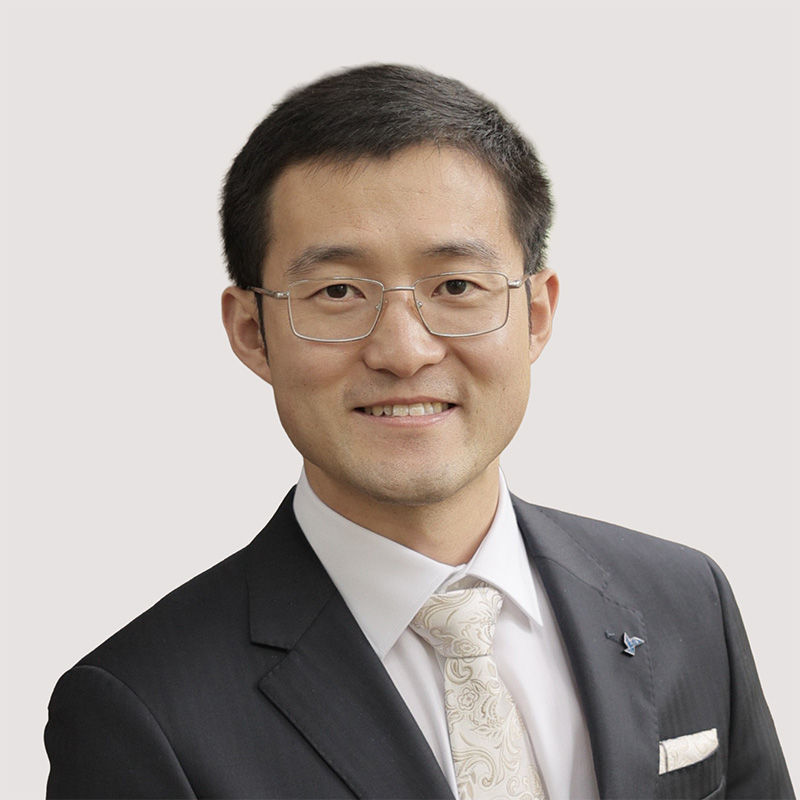
Xiaopeng ‘Gavin’ Bi
Xiaopeng ‘Gavin’ Bi completed his PhD at Adelaide University under the supervision of Prof. Gus Nathan, Dr Tim Lau and Dr Zhiwei Sun.
His project addressed a practical challenge in heavy industry: many lower-emissions processes for steel, cement and alumina rely on moving dense streams of particles through reactors, and performance depends heavily on how those particles spread, fall and mix, as well as how long they stay in the system. Gavin’s thesis focused on the underlying particle-flow behaviour relevant to equipment such as flash reactors for high-temperature mineral processing and falling-particle solar thermal receivers (in which solid particles are heated directly and can then be used for heat storage or as a source of high-temperature process heat).
Gavin’s work made three main contributions:
LinkedIn
- He developed a laser-based method for measuring the movement of both the particles and the surrounding fluid at the same time, with less signal interference and less complex data processing than many existing methods.
- He showed that falling particle curtains can be divided into distinct flow regions and broad operating regimes, improving understanding of how these dense particle streams evolve after leaving a hopper or feeder.
- In lab-scale reactor conditions relevant to drop-tube flash reactors, he measured how pulsed particle jets behave and reported the first residence-time measurements for this type of flow (i.e. how long particles remain in the flow). Understanding residence time is important because it helps determine reaction progress and mixing.