Hybrid Event
- This event has passed.
HILT CRC short course: Energy Storage for Heavy Industry Decarbonisation
February 2 @ 10:00 am - February 6 @ 5:30 pm AEDT
Hybrid Event
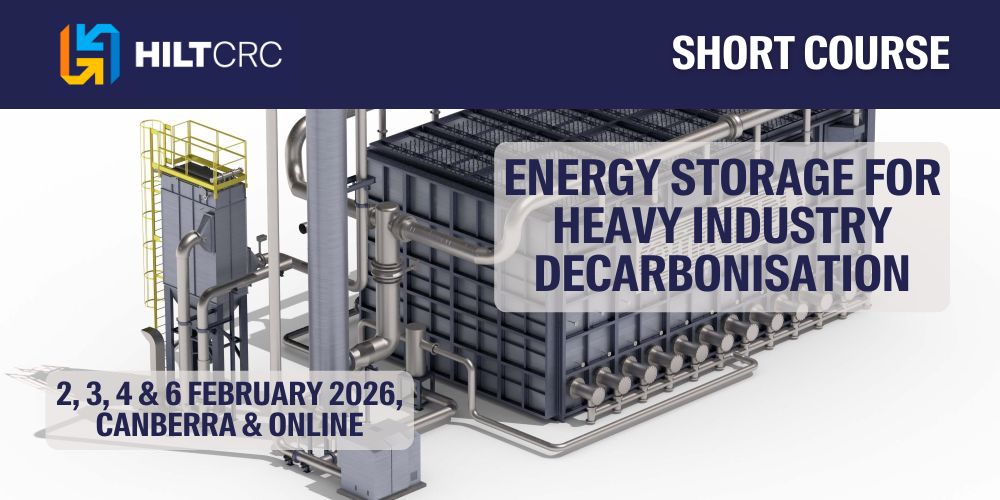
HILT CRC short course: Energy Storage for Heavy Industry Decarbonisation
2, 3, 4 and 6 February 2026 | ANU, Canberra, and online
This short course gives engineers and analysts knowledge to understand reliable storage strategies that cut emissions and cost while meeting heat, electricity or green-fuel needs.
Participants will develop their ability to choose the right storage for a site by understanding the full complement of technologies, their operational principles, response times, lifespans, costs, and operation and maintenance requirements, as well as how to tailor them for process, terrain and weather.
The course includes 4 online sessions, 2 hands-on computer labs and an in-person discussion and networking session (see below). All sessions are 2 hours.
We encourage people to attend the computer lab sessions in person. If this is not possible, we can provide the necessary scripts, but cannot guarantee that they will run smoothly without our direct technical support.
REGISTRATION: This course is free for HILT CRC Partners* and and includes lunch on both days and networking drinks on day 1.
COURSE DETAILS
Session 1: Introduction (Ye Wang)
10:00 – 12:00, Monday 2 February, 2026 online
This session covers the critical role of energy storage in dispatchable clean energy and decarbonisation, fundamentals and emerging technologies, the Australian landscape with key companies and demo projects, general storage analysis, market dynamics, and compares onsite versus offsite storage for industry.
Session 2: Thermal energy storage (Joe Coventry)
13:00 – 15:00, Monday 2 February, online
We will review various thermal energy storage (TES) technologies, focusing on their types, media, temperature ranges, compatible working fluids, commercial providers, technology readiness level (TRL) status, performance, cost, notable successes and failures, and potential integration with high-temperature industrial processes for decarbonisation.
Session 3: Electrical energy storage (John Pye)
13:00 – 15:00, Tuesday 3 February, online
We will examine the types, working principles, and storage duration of electrical energy storage systems, along with their cycle life, degradation rates, operation and maintenance requirements, and costs. The session will highlight both successful and failed examples, explore potential integration with high-temperature industrial processes, and conclude with a discussion on whether ‘electrify everything’ necessarily implies reliance on electrical energy storage, considering the key factors involved.
Session 4: Hydrogen Storage (Alireza Rahbari)
13:00 – 15:00, Wednesday 4 February, online
This session will cover hydrogen storage for industry, focusing on types, technology readiness levels, storage duration, safety protocols, operation and maintenance, and cost. We will explore potential integration with high-temperature industrial processes and discuss opportunities and challenges of onsite versus offsite storage for industry.
Session 5: Computer lab 1 (Ye Wang)
10:00 – 12:00, Friday 6 February, in person at ANU
This session will focus on modelling the dynamic performance of energy storage, covering the definition of charging and discharging rates, modes of operation, round-trip efficiency, and storage utilisation rate. The session will also address integration with photovoltaic (PV) and wind renewable systems through both lecture and tutorial.
Session 6: Computer Lab 2 (Ye Wang)
13:00 – 15:00, Friday 6 February, in person at ANU
This session will cover energy storage selection and sizing, addressing how to account for variable renewable energy, optimal dispatch strategies, incorporation of energy storage into financial models and planning.
Session 7: Closing seminar
15:30 – 17:30, Friday 6 February, in person at ANU
This session will conclude the course with discussions on policies that incentivise energy storage adoption in heavy industry, considering the need for additional support and possible forms it could take, followed by a networking event.
presenters
Dr Ye Wang, School of Engineering, The Australian National University (ANU)

Ye Wang is a Research Fellow in the School of Engineering at The Australian National University (ANU), with a background in mechanical engineering. Her expertise spans the design of concentrating solar thermal (CST) systems, optimisation of renewable energy systems, and technoeconomic, sensitivity, and risk analysis. She serves as a key manager for two open-source repositories dedicated to CST simulations – solsticepy and SolarTherm. Ye is also a key contributor to multiple HILT CRC research projects, including RP2.003 Green heat for industry, RP2.008 Lost production and variability, and RP2.009/RP2.017 Advancing the viability of high-temperature thermal energy storage for industrial applications.
Professor Joe Coventry, School of Engineering, ANU

Joe Coventry is a researcher and engineer at ANU’s School of Engineering. He is experienced in development and commercialisation of concentrating solar and energy storage technologies. He was previously Principal Engineer at Wizard Power, and led the development of the Big Dish CSP technology. With expertise in the field of CST and thermal energy storage (TES), his research advances knowledge and develops technologies to improve the competitiveness of CST and TES as well as drive uptake and rapid decarbonisation in the power and heavy industrial sectors. Joe leads HILT CRC Project RP2.017.
Associate Professor John Pye, School of Engineering, ANU

John Pye has a background in mechanical engineering with an emphasis on thermal energy systems including system design, heat transfer, non-imaging optics, computational fluid dynamics, thermodynamics and simulation. His recent focus is on system-level design optimisation, heavy industrial decarbonisation, fluidised bed ironmaking and biomass gasification. John leads HILT CRC Project RP2.008 as well as an ARENA-funded project on de-risking hydrogen ironmaking.
Dr Alireza Rahbari, School of Engineering, ANU

Alireza Rahbari is a Senior Research Fellow at ANU. His research focuses on renewable energy, system-level modelling, dynamic system-level simulation, porous media, technoeconomic assessment, heat transfer enhancement, phase change thermal storage and combustion of dust particles. Research interests include solar fuel production via supercritical water gasification of algae biomass; solar thermal beneficiation, sintering and pelletisation of iron ore; hydrogen-based steelmaking; and advanced thermal solutions. Alireza leads HILT CRC Project RP1.018 Optimal fast-start pathways to green steel via magnetite.