Low-Carbon Alumina Production short course – Perth
Low-Carbon Alumina Production is a two-day professional development course providing fundamental knowledge and practical tools for industry to implement low-carbon alumina refining technology and process innovation. This course will benefit industry, researchers, regulators or anyone interested in the decarbonisation of alumina production.
The course will provide a comprehensive overview of alumina production fundamentals focused on energy and decarbonisation (i.e. not chemistry and other complexities). The course has been structured to align with the ARENA Roadmap for Decarbonising Australian Alumina Refining, with a focus on:
- decarbonising the steam system
- decarbonising the calcination process
- system design and circularity opportunities for low-carbon alumina refining.
Each session will also cover new and emerging technologies and refinery configurations, highlighting current applications, benefits and implementation challenges. Case studies will provide examples and opportunity for discussion on real-life applications.
Limited places available – book now to reserve your place.
AGENDA
Session 1: Decarbonising the aluminium production process – Dr David Cochrane
- Alumina and aluminium production overview
- Decarbonisation challenges for alumina producers
- Global trends in low-carbon alumina production – technology & markets.
Session 2: Decarbonising the steam system – Dr Woei Saw
- Steam & compressor system fundamentals
- Low-carbon digestion/Bayer technologies and options
- Case studies discussion: high-pressure/low-pressure applications of thermal energy storage (TES) & mechanical vapour recompression (MVR).
Session 3: Decarbonising the calcination process – Professor Gus Nathan
- Fundamentals (combustion, heat transfer, thermodynamics)
- Technology options: retrofitting existing calciners, new net-zero calciners & steam recovery integration
- Case studies discussion: retrofits & new net-zero calciners (e.g. Calix or current original equipment manufacturers).
Session 4: System design and circularity opportunities for low-carbon alumina – all presenters
- Renewable energy, hydrogen supply and integration options
- Carbon capture, utilisation and storage (CCUS)
- Beneficiation and waste reduction strategies.
presenters
Gus Nathan, Professor in Mechanical Engineering at The University of Adelaide and Research Director, HILT CRC
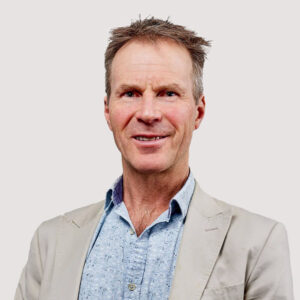
Prof. Gus Nathan is a Professor in Mechanical Engineering at the University of Adelaide, a Fellow of the Academy of Technological Sciences and Engineering, the Combustion Institute and Engineers Australia, a recipient of a Discovery Outstanding Researcher Award from the Australian Research Council and an ATSE KH Sutherland medallist. He was the bid leader for and is now the Research Director of HILT CRC. This builds on his leadership of an ARENA-funded program to develop technology with strong potential to provide energy to the Bayer alumina process with concentrated solar thermal heat in partnership with Alcoa and Hatch, together with his co-leadership of program to develop innovative hydrogen production technologies within the Future Fuels Cooperative Research Centre.
Gus has led the development of six technology platforms, three of which are in ongoing commercial use and include the flame for Sydney Olympic Relay Torch, while three are currently being upscaled to decarbonise heavy industry. Gus has published more than 300 papers in international journals, 250 in peer reviewed conferences, 50 commissioned reports and 13 patents. He is also the founding chair of the High Temperature Minerals Processing (HiTeMP) Forum and co-founder of the Hydrogen Production Technologies (HyPT) forums, both of which attract some 170 delegates from more than 13 countries, drawn equally from industry, research and government agencies. He is also a joint founder of the international ISF Workshop for the Measurement and Computation of Reacting Flows With Carbon Nanoparticles, which engages some 100 researchers from around the world and is aligned with his own speciality in optical diagnostic methods to de-risk emerging technologies in hydrogen production and heavy industrial processes.
Dr David Cochrane, former South32 Manager Process Engineering and Bauxite and Alumina Technology.
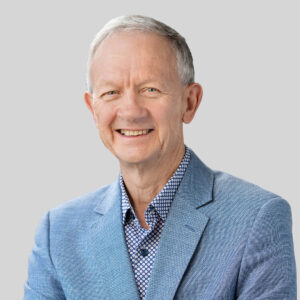
David is a respected and knowledgeable process engineer with over 30 years of experience working in the minerals industry. He previously worked as Manager Process Engineering for South32 and has unique technical and operational processing experience with two of Australia’s most important mineral commodities – bauxite/alumina and iron ore/direct reduced iron (DRI).
Conversant in the challenges and opportunities for the decarbonisation of heavy industry in Australia, he is uniquely experienced in the process development, design and operation of the Pilbara’s first DRI/hot-briquetted iron (HBI) production plant based on the hydrogen reduction of iron ore fines in a fluidised bed process. .
David’s previous roles have also included: Chair of ICMM Tailings Working Group; Chair of the Alumina Technical Panel; Member Bauxite Alumina Committee of the IAI; Executive Committee member for AQW; and Member of the University of Western Australia Industry Advisory Panel for the School of Chemical Engineering. He holds graduate and postgraduate degrees in Chemical Engineering, completing his PhD at The University of Queensland.
Dr Woei Saw, The University of Adelaide
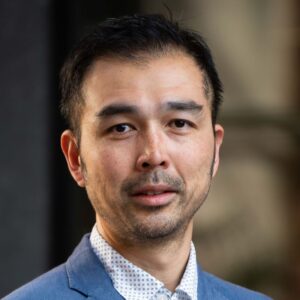
Dr Woei Saw is a Senior Lecturer in the School of Chemical Engineering at The University of Adelaide. With an exemplary track record in the development and demonstration of novel technology in the decarbonisation of high-temperature industrial processes, Saw leads HILT CRC’s RP1.013 HILT CRC Alumina refineries’ next-generation transition (AlumiNEXT™) Project. He has also developed a patent on net-zero steam alumina calcination, which allows steam generated from the alumina calcination process to be recovered and utilised in the bauxite digestion within the Bayer process.
Saw has research and hands-on experience in designing and operating pilot-scale systems, and expertise relevant to thermal conversion technologies. He has previously been involved in concentrated solar thermal (CST) research projects funded by ARENA and co-led the development of process integration (including techno-economic assessment) of CST plant and high-temperature storage into alumina calcination process and contributed to scaling up of and lab-scale demonstration of The University of Adelaide solar expanding vortex receiver (SEVR). Furthermore, he is working towards a transformation of agricultural waste through the development of technologies to produce value-adding energy co-products.